
Bitumen Emulsion Plant
A Bitumen Emulsion Plant is an essential production system for road construction applications such as surface treatments, tack coat, slurry seal, crack sealing, and pavement maintenance. The system produces bitumen emulsion by dispersing bitumen into water with the help of emulsifying agents, making the binder suitable for application at lower temperatures.
MBA manufactures turnkey bitumen emulsion plants capable of producing stable cationic and anionic emulsions in accordance with international road construction standards. Each system is designed to provide accurate dosing, homogeneous mixing, reliable process control, and consistent emulsion quality.
Our automatic bitumen emulsion plant solutions can be configured according to the required production capacity, emulsion type, automation level, and project conditions. The systems are suitable for asphalt producers, road contractors, municipal maintenance projects, and industrial bitumen processing facilities.
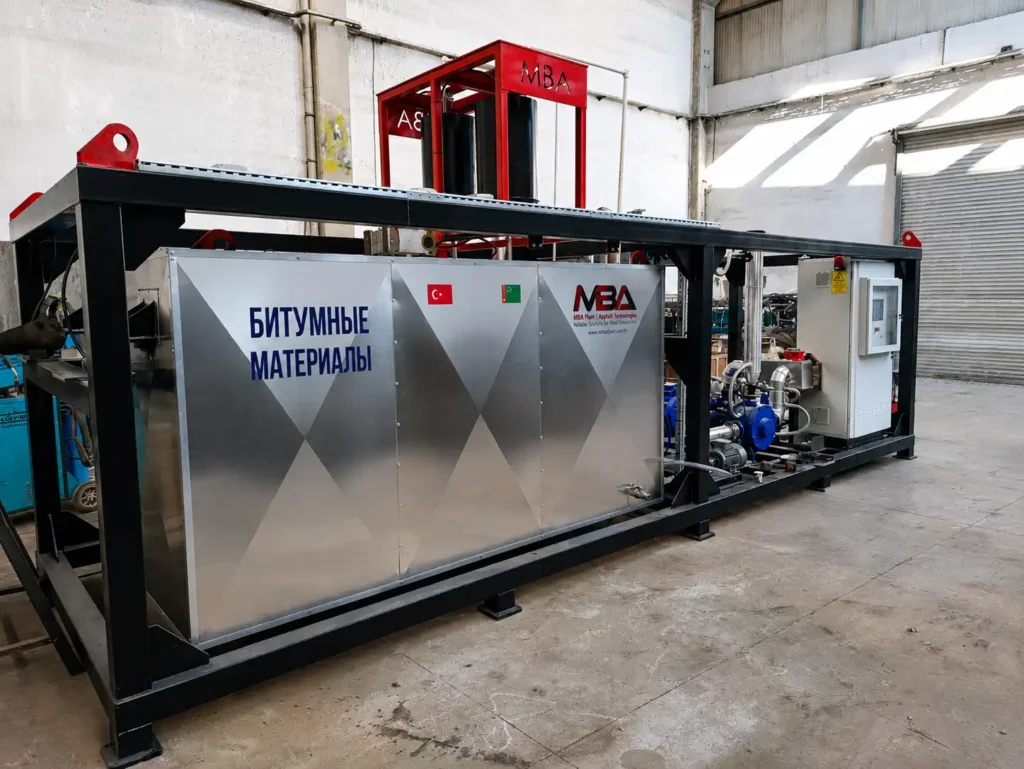
What Is a Bitumen Emulsion Plant ?
A Bitumen Emulsion Plant is an industrial production system that mixes bitumen with an aqueous solution consisting of water, emulsifier, and acid in controlled proportions according to the required emulsion grade. The components are processed through a colloid mill for bitumen emulsion to produce a stable and homogeneous final product.
Bitumen emulsions are generally classified as cationic or anionic emulsions. Anionic emulsions are commonly used in insulation and waterproofing applications, while cationic emulsions are widely preferred for asphalt paving, surface treatment, tack coat, and rural road construction.
Compared with conventional hot bitumen applications, bitumen emulsions can be applied at lower temperatures and may reduce energy consumption and operating costs. A properly designed automatic bitumen emulsion plant ensures accurate dosing, consistent particle size, reliable process control, and stable emulsion quality.
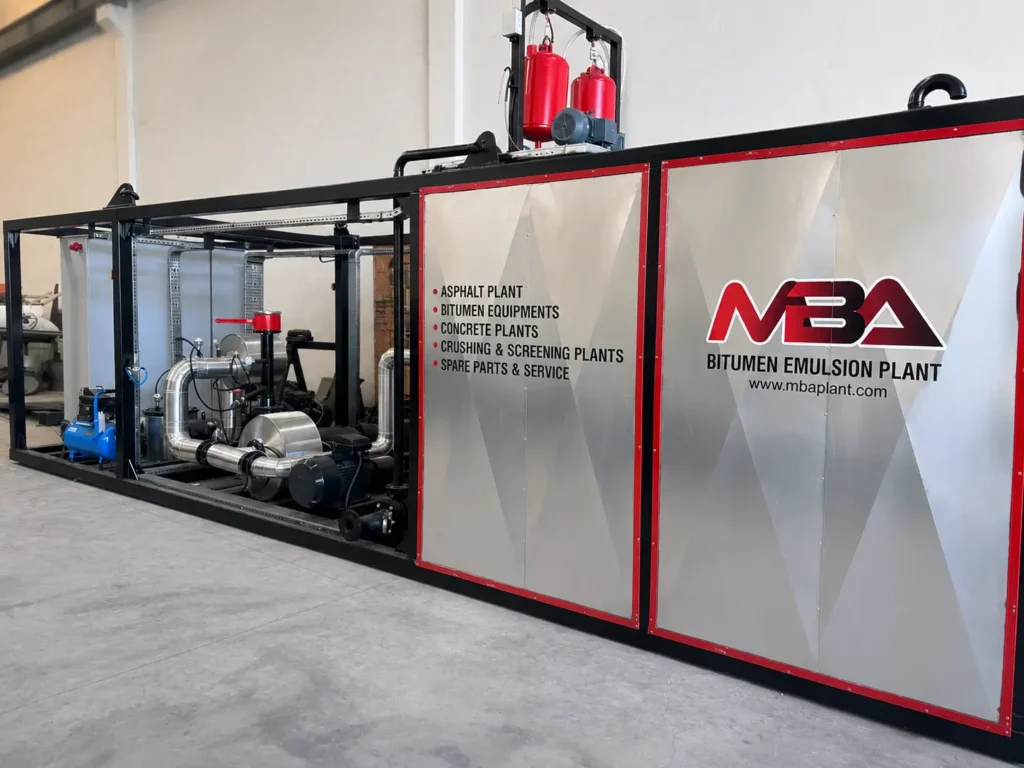
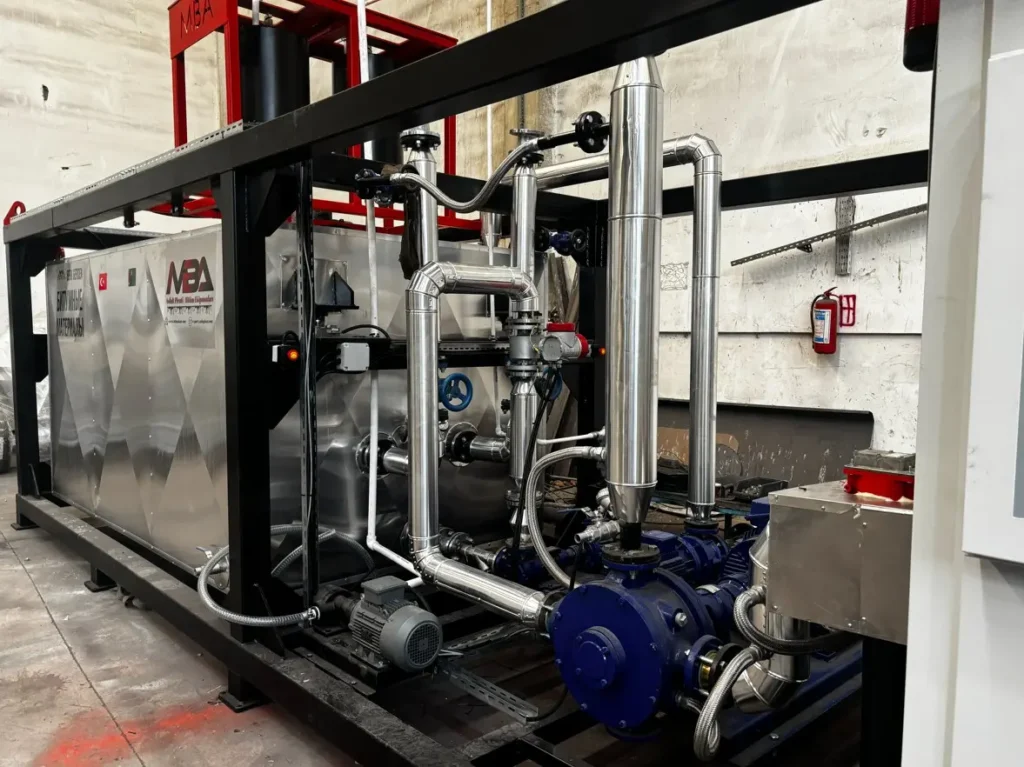
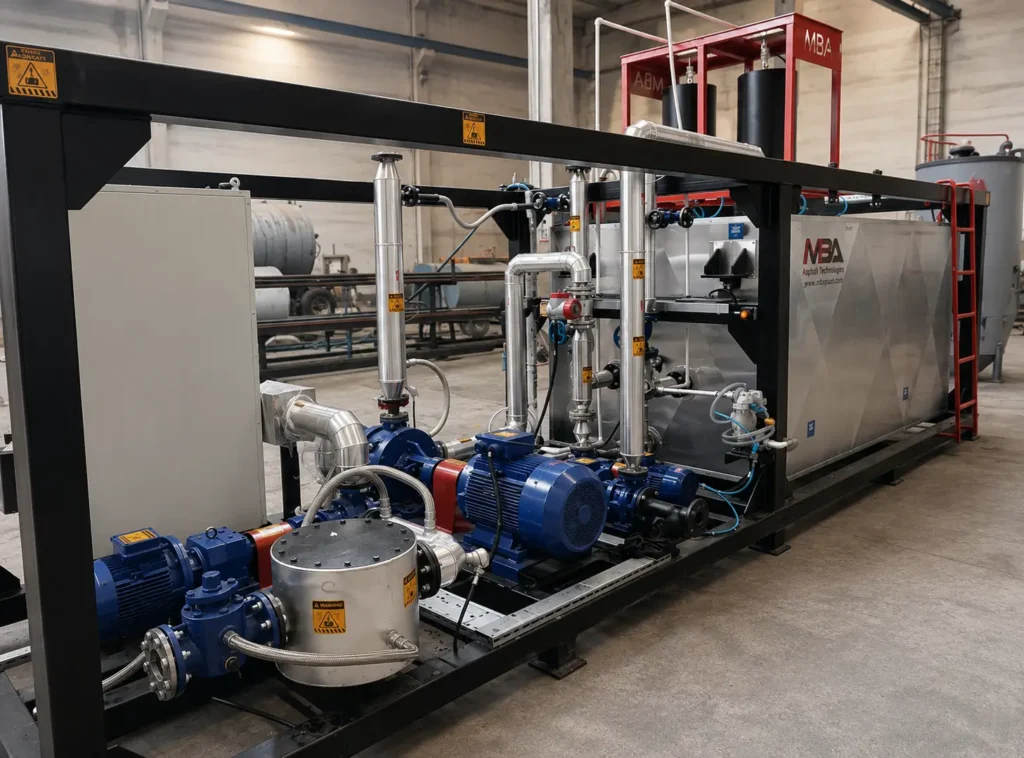
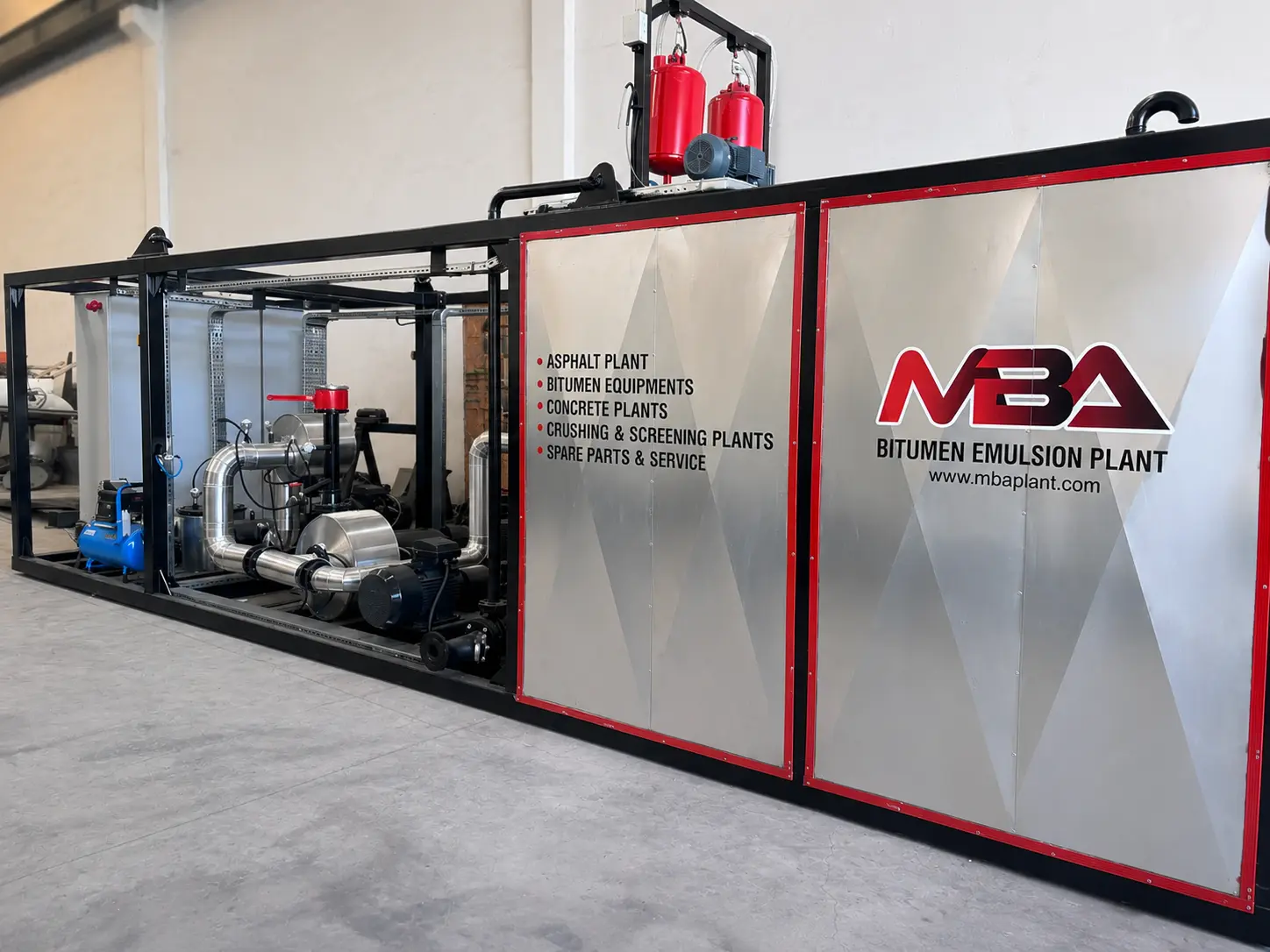
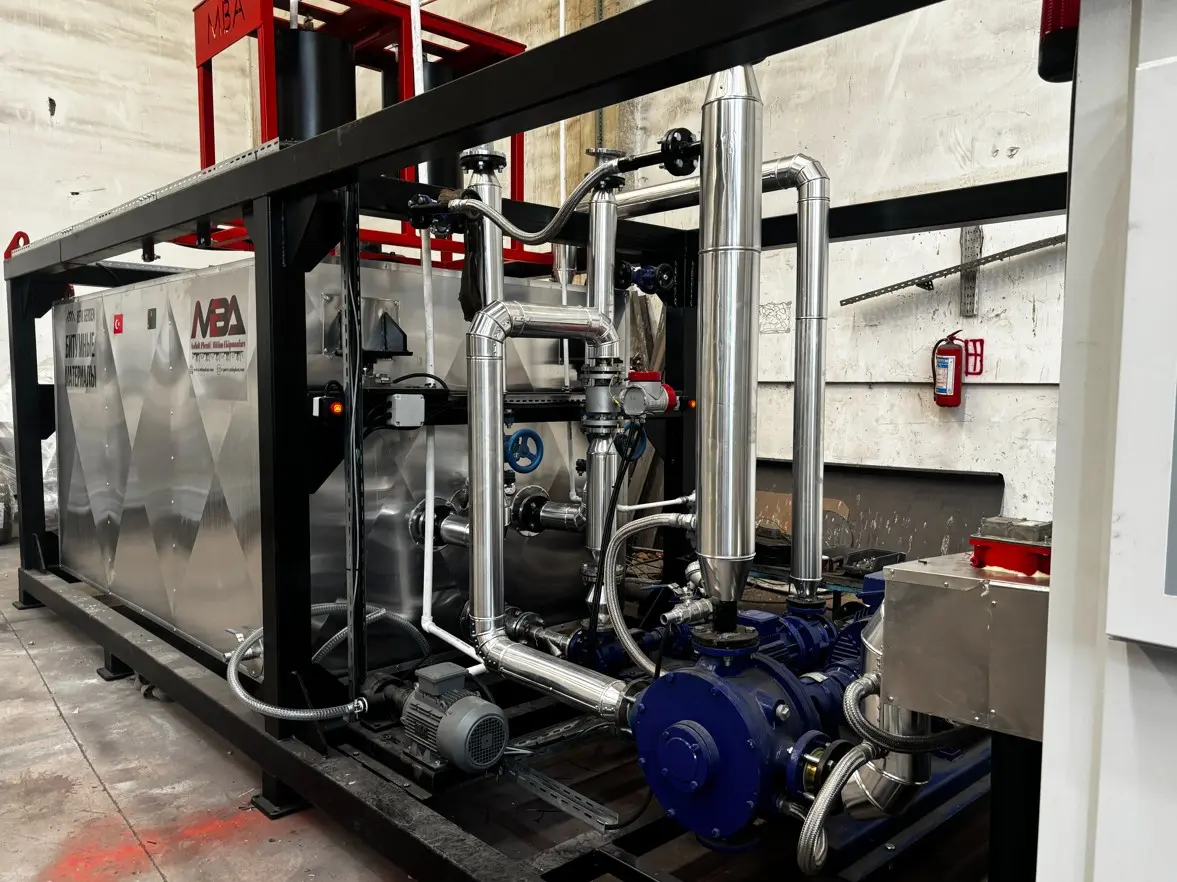
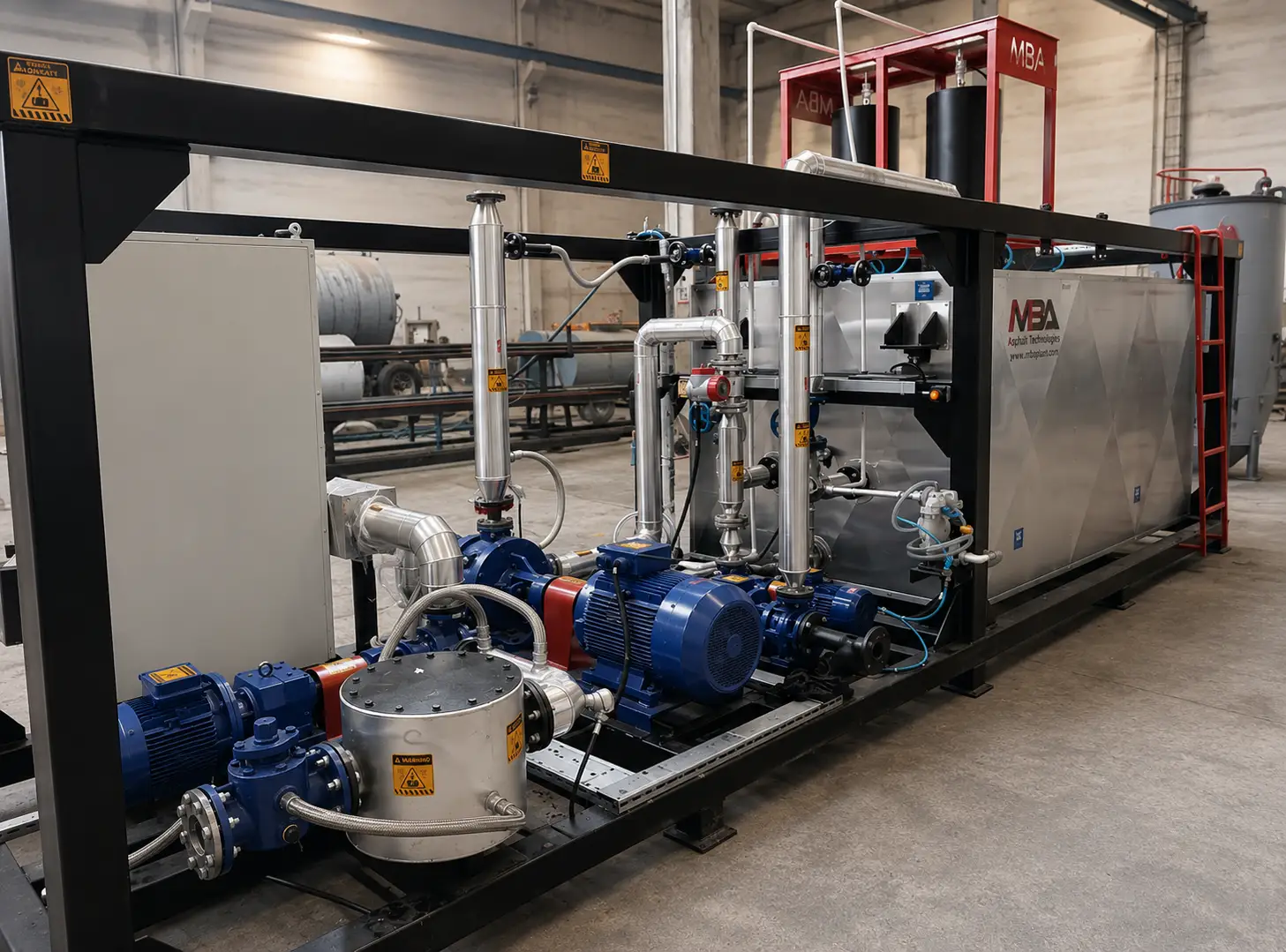
Bitumen Emulsion Plant Technical Specifications
MBA manufactures Bitumen Emulsion Plants in different capacities and configurations according to project requirements. The table below presents the standard production capacities, colloid mill capacities, bitumen pump capacities, solution pump capacities, and heating system options of our most commonly supplied models.
| Production Capacity | Colloid Mill Capacity | Bitumen Pump Capacity | Solution Pump Capacity | Heating System |
| 5 t/h | max. 5 t/h | 5 m³/h | 4 m³/h | Electric / Thermal Oil |
| 10 t/h | max. 10 t/h | 10 m³/h | 6 m³/h | Electric / Thermal Oil |
| 15 t/h | max. 15 t/h | 15 m³/h | 8 m³/h | Electric / Thermal Oil |
| 20 t/h | max. 20 t/h | 20 m³/h | 12 m³/h | Electric / Thermal Oil |
What Are the Technical Advantages of MBA Bitumen Emulsion Plants ?
Designed by our engineering team as compact monoblock systems on a single chassis, MBA Bitumen Emulsion Plants offer the following technical features and advantages:
5–20 t/h Production Capacity:
High-efficiency bitumen emulsion production capacity that flexibly meets the daily emulsion requirements of road projects of different sizes.
Dual Heating System Options:
Depending on the available energy infrastructure at the site, the plant can be supplied with either a thermal oil heating system or an electric resistance heating system.
High-Performance Colloid Mill:
A high-quality colloid mill for bitumen emulsion reduces bitumen particles to the ideal micron size within the aqueous phase, ensuring a stable and homogeneous emulsion.
Anti-Foaming Dual-Inlet Mill Design:
A specially designed dual-inlet mechanism prevents air entrainment into the product, eliminating foaming problems that may negatively affect chemical stability and storage quality.
Stainless Steel Solution Tank:
A specially manufactured stainless steel solution tank provides strong corrosion resistance against acid and chemical additives while ensuring homogeneous mixing.
High-Precision Acid and Emulsifier Weighing Unit:
A load-cell-supported precision weighing system manufactured from stainless steel provides accurate dosing of acid and emulsifier while resisting aggressive chemicals.
Flowmeter-Based Flow Control:
Bitumen and solution flow rates are measured continuously by flowmeters and fed into the system with high accuracy, minimizing operator error.
Compact Single-Chassis Design:
The monoblock structure reduces transport costs, simplifies relocation between job sites, and minimizes installation and commissioning time.
PLC Control System and Touchscreen Panel:
An intelligent automation system allows operators to monitor and control all production stages, valves, flow rates, and temperatures in real time through an industrial touchscreen.
Automatic Dosing with PID-Controlled Pumps:
PID-controlled pump groups automatically balance liquid flow rates independently of mechanical fluctuations, ensuring highly accurate and stable dosing.
Recipe Storage Function:
Formulations for different emulsion grades, such as CRS-1, CRS-2, and slow-setting emulsions, can be saved in the system and recalled with a single command for fast production changeover.
User-Friendly Software and Multilingual Support:
A simple and intuitive interface allows operators to manage the automatic bitumen emulsion plant easily, while multilingual software support makes the system suitable for international projects.
How Does a Bitumen Emulsion Plant Work? Production Process
Bitumen emulsion production is based on combining two immiscible liquids—bitumen and water—into a stable and homogeneous mixture with the help of chemical additives. In the MBA Bitumen Emulsion Plant, this process is carried out automatically in four main stages:
1. Preparation of the Water and Chemical Solution
First, water, hydrochloric acid (HCl), and emulsifier additives required to form the aqueous phase are transferred into the stainless steel solution tank. The chemical components are dosed according to the production recipe by means of a high-precision acid and emulsifier weighing unit equipped with load cells.
The mixer inside the tank ensures that the acid and emulsifier dissolve completely and homogeneously in the water, preparing a stable solution for the next production stage.
2. Precision Dosing with PID-Controlled Pumps and Flowmeters
The prepared solution and the hot bitumen, heated to the required viscosity using a thermal oil system or electric resistance heaters, are pumped simultaneously toward the colloid mill.
At this stage, PID-controlled pumps and flowmeters are used for precise dosing and real-time flow measurement. The automation system continuously monitors the flow rates and ensures that bitumen and solution are fed to the mill at the required proportions, for example 60% bitumen and 40% solution, depending on the selected formulation.
3. Micronization and Homogenization in the Colloid Mill
The bitumen and aqueous solution enter the high-speed colloid mill for bitumen emulsion, which is the core component of the production system. Inside the mill, the product is exposed to intense shear forces between the high-speed rotor and stator.
This process reduces the bitumen droplets to approximately 1–5 microns, allowing them to remain suspended in the water phase. The special dual-inlet mill design minimizes air entrainment and prevents foaming during high-speed processing.
4. Stable Emulsion Discharge and Storage
The cationic or anionic bitumen emulsion leaving the mill is transferred directly to the bitumen emulsion storage tank without foaming or phase separation.
The finished emulsion maintains its fluidity and stability even at ambient temperature and is ready for loading into distributors for applications such as surface dressing, tack coat, slurry seal, and road maintenance.
BITUMEN EMULSION PLANT MANUFACTURER
Request a Quote for a Bitumen Emulsion Plant Tailored to Your Project !
Frequently Asked Questions About Bitumen Emulsion Plants
Find answers to the most common questions about bitumen emulsion plant selection, capacity calculation, certification, turnkey systems, and operational safety.
What Is Included in a Turnkey Bitumen Emulsion Plant ?
MBA provides complete turnkey solutions to establish a reliable bitumen emulsion production system at your project site.
In addition to the bitumen emulsion plant shown in the table, the complete system may include a bitumen service tank integrated with the plant, an agitated bitumen emulsion storage tank for safe product storage, and a high-efficiency thermal oil heater designed to supply the heating requirements of the entire system.
All equipment is engineered as an integrated package and supplied as a turnkey bitumen emulsion plant, ensuring compatibility between process equipment, storage tanks, heating systems, piping, automation, installation, and commissioning.
Can the Plant’s Heating System Be Customized According to Site Infrastructure ?
Yes. The heating system of the Bitumen Emulsion Plant can be customized according to the available energy sources and infrastructure at the project site.
The plant can be integrated with a thermal oil heating system. For sites without an existing thermal oil line, the system can instead be supplied with direct electric resistance heating.
In both configurations, the PLC control system precisely maintains the ideal operating temperatures of the bitumen and aqueous solution, ensuring stable viscosity, accurate dosing, and consistent emulsion quality.
What Measures Are Taken Against Corrosion Caused by Hydrochloric Acid and Chemical Additives ?
Hydrochloric acid (HCl), emulsifiers, and other chemical additives used in the production of cationic bitumen emulsion have highly corrosive properties. To prevent corrosion, all surfaces, valves, pumps, solution preparation lines, the stainless steel solution tank, and the high-precision acid and emulsifier weighing unit that come into direct contact with acidic chemicals are manufactured from stainless steel, which offers excellent chemical resistance.
This material selection provides long service life, safe operation, and reliable protection against corrosion throughout the Bitumen Emulsion Plant.
How Can Operators Switch Between Different Road Specification Recipes Such as CRS-1, CRS-2, and CSS ?
Thanks to the recipe storage function and user-friendly PLC software integrated into the Bitumen Emulsion Plant, operators can switch between different emulsion formulations within seconds.
When the required emulsion grade—such as rapid-setting, medium-setting, or slow-setting—is selected from the touchscreen, the system automatically readjusts the bitumen and chemical solution flow rates using PID-controlled pumps and flowmeters. No manual valve adjustment is required.
This automated recipe management system improves production consistency, reduces operator error, and enables fast changeover between grades such as CRS-1, CRS-2, and CSS bitumen emulsions.
How Are Operator Control and Multilingual Support Provided for International Projects ?
As a manufacturer exporting machinery to global markets, we develop the automation software of our Bitumen Emulsion Plant with multilingual operation support.
The industrial touchscreen control panel can be supplied with language options such as English, Russian, French, and Arabic. This allows local operators at international project sites to manage the system safely and confidently in their own language without technical confusion.
The user-friendly interface simplifies production monitoring, recipe selection, alarm management, and process control, while reducing operator errors and training requirements.
What Determines Bitumen Emulsion Plant Prices and Which Factors Affect the Investment Budget ?
Bitumen emulsion plant prices are not based on a fixed standard package. Each system is customized according to the project requirements, logistics conditions, production targets, and site infrastructure. The main factors affecting the investment budget are as follows:
Production Capacity:
The selected hourly production capacity of the Bitumen Emulsion Plant, typically ranging from 5 t/h to 20 t/h, directly affects the equipment size, pump capacities, colloid mill capacity, and overall plant cost.
Heating System Selection:
Depending on the available site infrastructure, the plant can be supplied with either a thermal oil heating system or an electric resistance heating system. The selected heating method influences both the initial investment and operating costs.
Material and Component Quality:
The size and material grade of corrosion-resistant stainless steel solution tanks, as well as the technology level of flowmeters, PID-controlled pumps, valves, and automation equipment, have a direct impact on the final price.
Turnkey Equipment Scope:
The total cost also depends on whether the project includes only the emulsion production unit or a complete turnkey package with a bitumen service tank, agitated bitumen emulsion storage tank, thermal oil heater, piping system, automation, installation, and commissioning.
For every system manufactured and exported from our factory in Türkiye, MBA determines the most suitable plant configuration according to the technical requirements of the project and the available investment budget.
Other Bitumen Technologies
MBA offers a complete range of bitumen equipment and processing systems for asphalt plants, bitumen terminals, and road construction projects. Our product portfolio includes bitumen tanks, PMB plants, bitumen melting units, cutback bitumen plants, thermal oil heaters, and auxiliary bitumen equipment designed for reliable and efficient operation.
Browse the related product categories below to find the right solution for your bitumen storage, heating, and processing requirements.
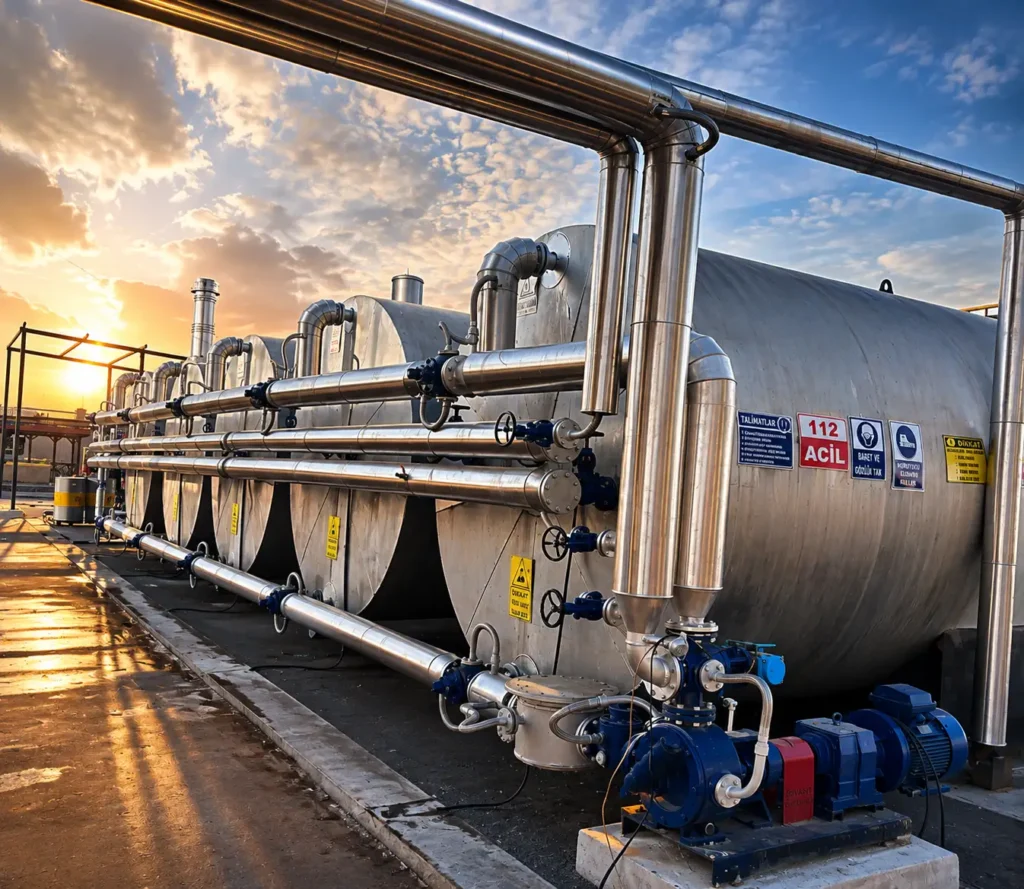
Bitumen Tank
Bitumen tanks are designed for the safe storage and heating of bitumen at the required operating temperature. Available with electric or hot oil heating systems, they can be manufactured in various capacities to meet different project requirements.
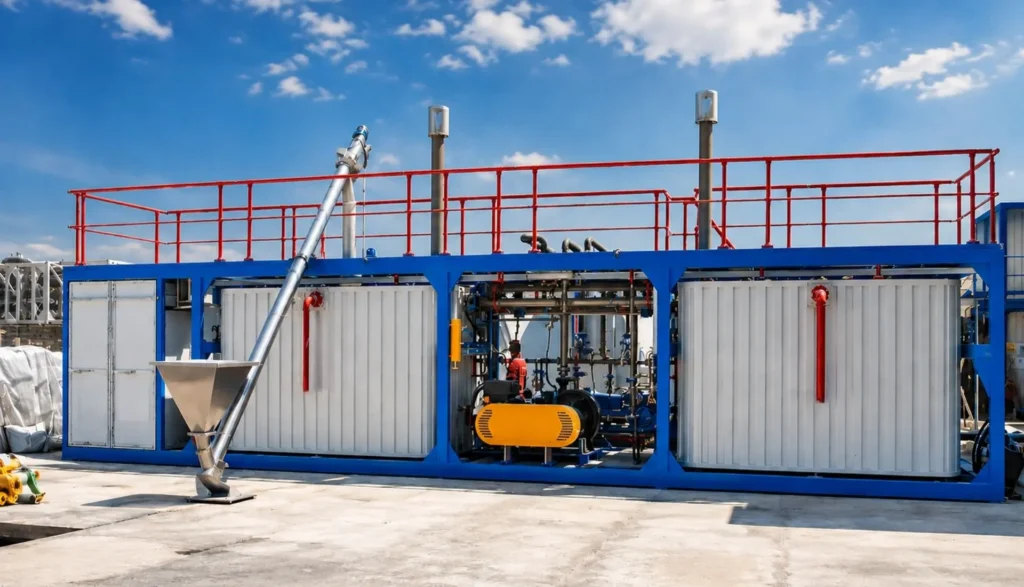
Polymer Modified Bitumen (PMB) Plant
PMB plants are used for the production of high-performance polymer modified bitumen using SBS, APP, EVA, and other polymer additives. These systems ensure homogeneous mixing, accurate dosing, and efficient production processes.
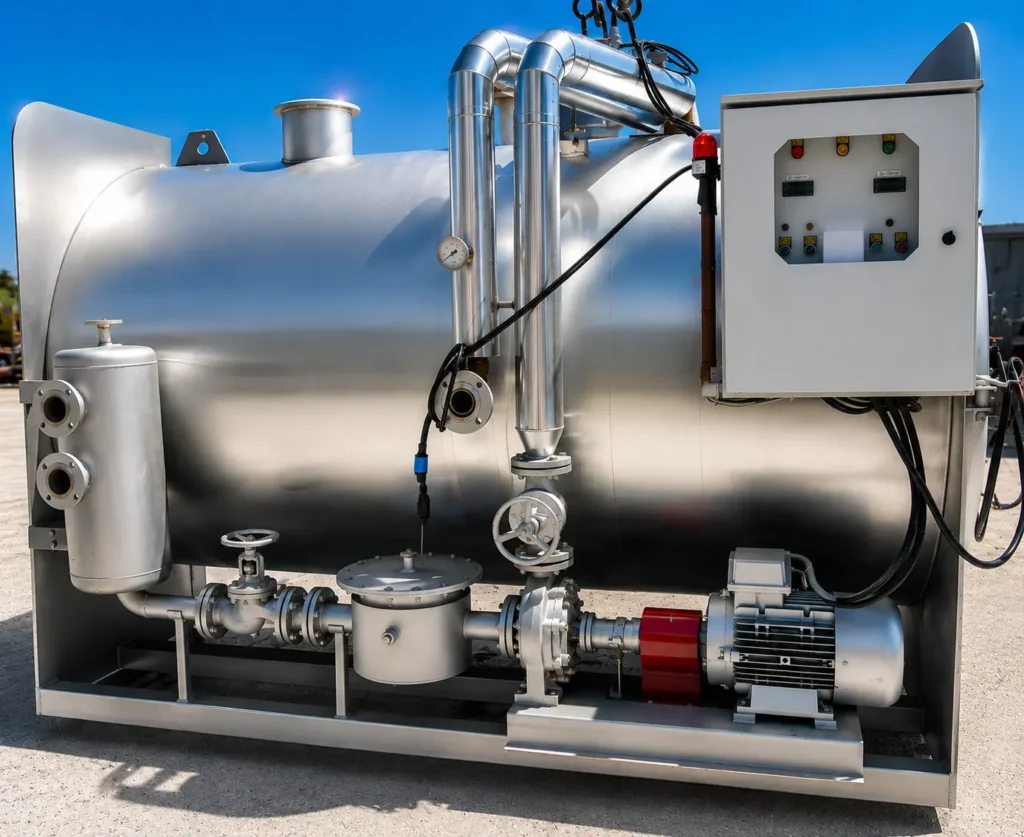
Hot Oil Boiler
Hot oil boilers are used for heating bitumen tanks and industrial process equipment. They provide efficient thermal energy transfer, high operating efficiency, and reliable performance under demanding conditions.
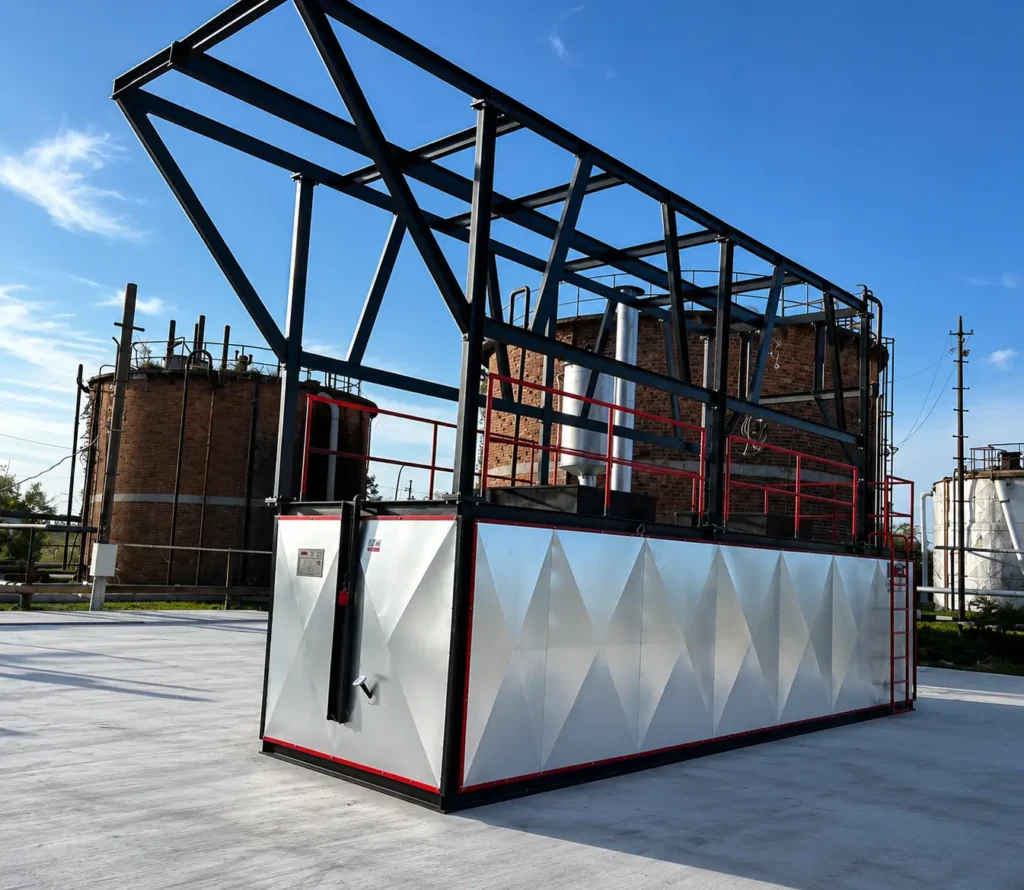
Big Bag Bitumen Decanter
Big Bag Bitumen Decanters are designed to efficiently melt bitumen supplied in jumbo bags and prepare it for transfer to storage or production systems. With high melting capacity, energy-efficient operation, and user-friendly design, these systems provide an ideal solution for bitumen terminals, asphalt plants, and industrial bitumen processing facilities.
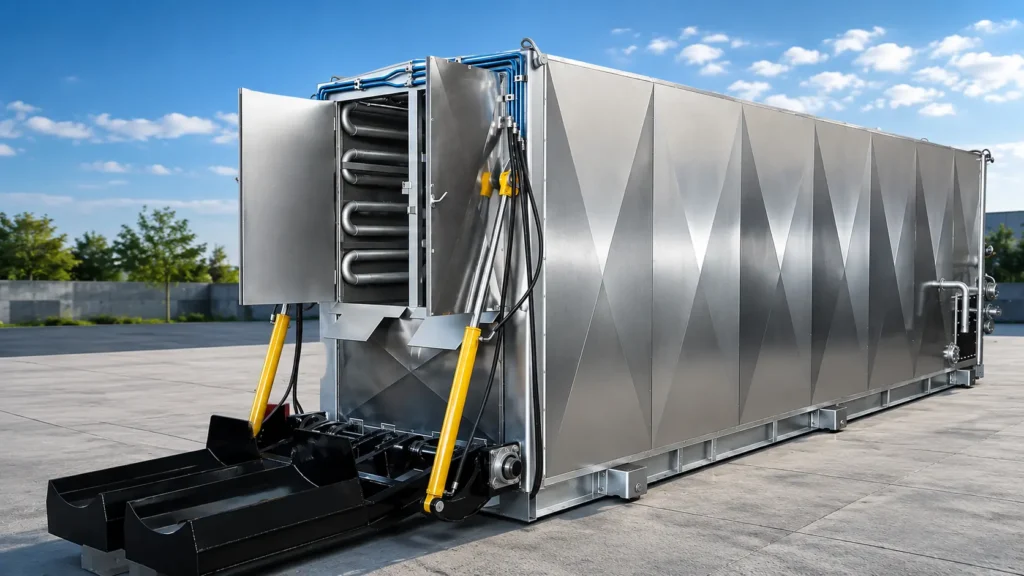
Drum Bitumen Decanter
Drum Bitumen Decanters are used for the controlled melting of bitumen stored in steel drums. Their high melting efficiency, low energy consumption, and reliable operation ensure a continuous bitumen supply for asphalt production and bitumen processing applications. These systems are widely preferred for projects where bitumen is delivered in drum packaging.
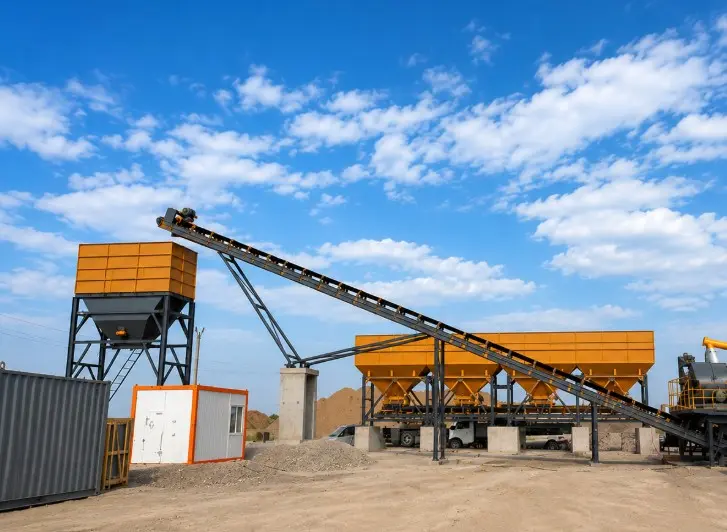
Wet Mix Macadam (WMM) Plant
Wet Mix Macadam (WMM) Plants are designed for the accurate proportioning and mixing of aggregates, water, and additives to produce high-quality road base and subbase materials. These plants provide high production capacity, reliable operation, and consistent mixture quality for road construction and infrastructure projects.
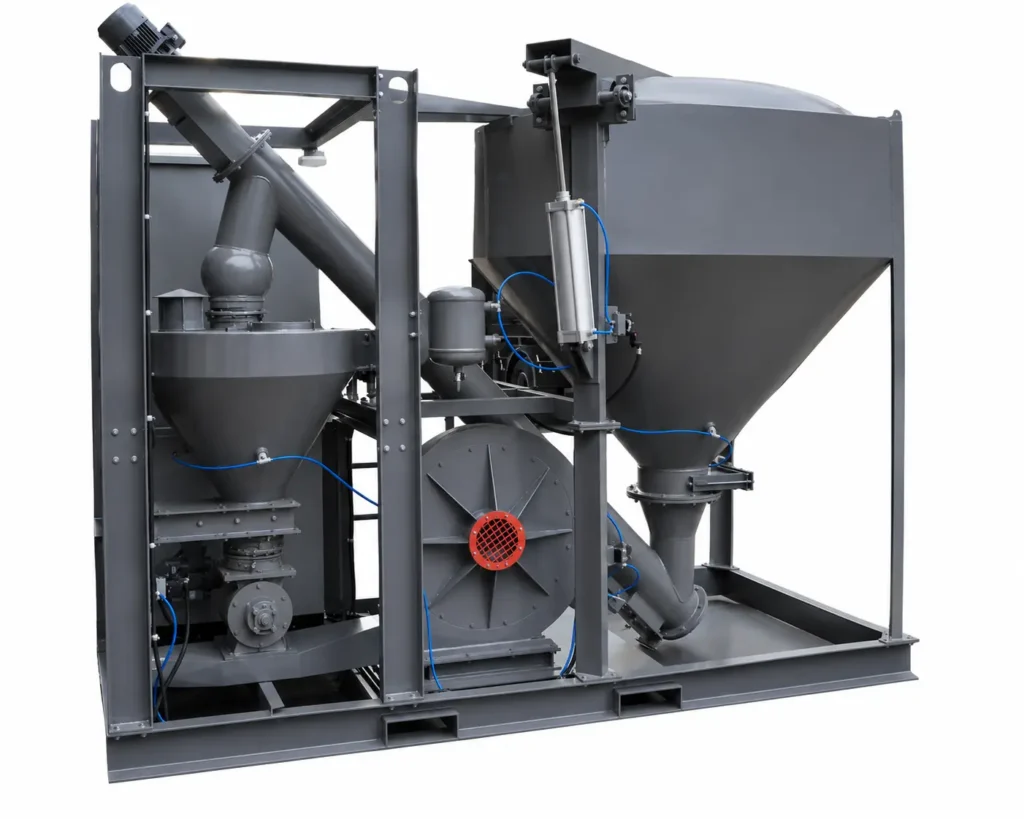
Cellulosic Fiber Additive Unit
Cellulosic Fiber Additive Units ensure the precise and homogeneous dosing of cellulose fibers into the asphalt mixing process. Designed for SMA (Stone Mastic Asphalt) and modified asphalt production, these systems improve mixture stability, reduce binder drain-down, and enhance pavement performance.
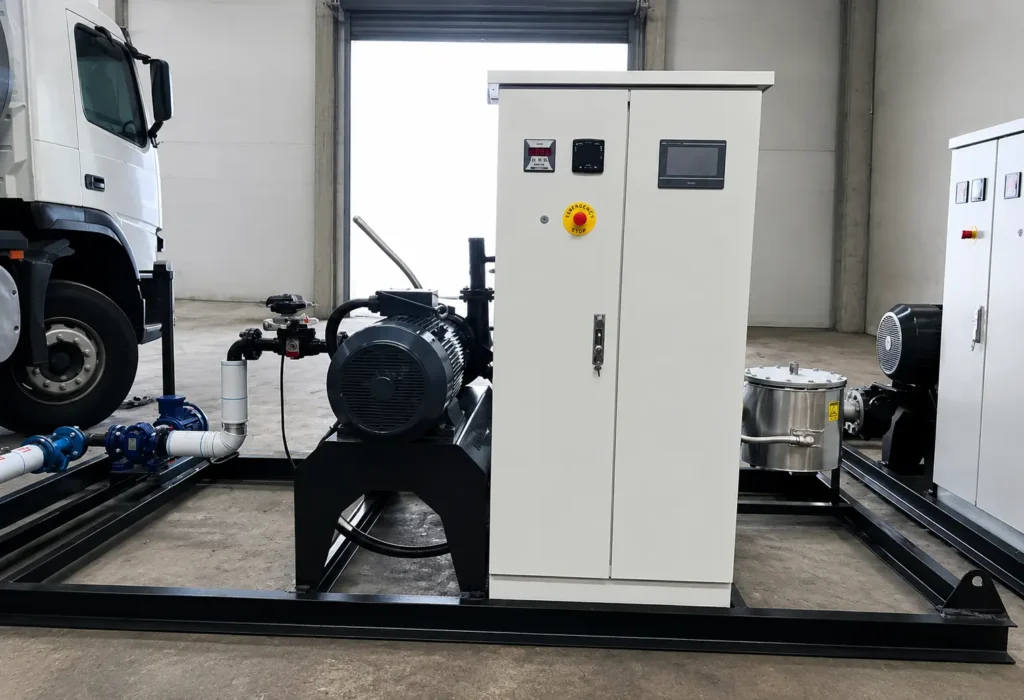
Cutback Bitumen Plant
Cutback Bitumen Plants are designed for the controlled blending of bitumen and solvents to produce high-quality cutback bitumen. Equipped with precise dosing and automated process control systems, these plants ensure consistent product quality for road construction, maintenance, and surface treatment applications.